
Does Your Pet’s Constant Eye Tearing Need a Surgical Fix?
Constant tearing does not always call for surgery, but when an eyelid is the cause, it usually does. Tearing, the watery overflow vets call epiphora, is a symptom with a long list of possible causes, from allergies and a blocked tear duct to a scratched cornea. The ones that need a surgical fix are structural: entropion, where the lid rolls inward and lashes scrape the eye, and ectropion, where the lid droops outward and leaves the surface exposed. Both keep producing tearing, discharge, and redness that look like a minor infection, which is why tearing that keeps coming back despite drops deserves a closer look at the lid itself.
Harbor Pines Veterinary Center in Harbor City is AAHA-accredited and equipped for soft tissue surgery, including eyelid correction, as part of our comprehensive veterinary services. We use in-house diagnostics to confirm what is actually driving the tearing before recommending anything, since the right fix depends entirely on the cause. If your dog or cat has been tearing persistently or an eyelid looks like it is sitting differently, request an appointment and we will take a careful look.
What Persistent Tearing Tells You
- Tearing is a symptom, not a diagnosis: the cause decides whether surgery is needed.
- Structural causes usually need surgery: entropion and ectropion rarely resolve with drops.
- Other causes do not: allergies, blocked ducts, and infections are managed differently.
- Lingering tearing earns an exam: chronic surface irritation can scar the cornea over time.
Why Does My Pet’s Eye Keep Tearing?
Tearing keeps going when something irritates the eye’s surface or when tears cannot drain normally. The signs of eye pain that travel with it, squinting, pawing, redness, and eye discharge, help point to the cause. Some sources are medical and clear up with treatment, while others are structural and keep the eye watering until the anatomy is fixed.
The practical question is which group your pet falls into. Allergies, irritants, a blocked tear duct, or an infection cause tearing that responds to medication or a minor procedure. A lid that rolls in or droops out causes tearing that will not stop until the lid is repositioned. Sorting one from the other is the whole point of the exam.
What Is Actually Causing the Tearing?
Reading the tearing alongside its other clues narrows the cause quickly.
| Cause of the tearing | Other clues | Usually needs surgery? |
| Entropion (lid rolls in) | Squinting, one eye, a predisposed breed | Yes |
| Ectropion (lid droops out) | Sagging lid, exposed pink, recurrent infection | Often |
| Blocked tear duct | Wetness without much redness, heavy staining | Sometimes a procedure |
| Allergies or irritants | Both eyes, seasonal, itchy | No, managed medically |
| Corneal ulcer or injury | Sudden pain, squinting, cloudiness | No, treated directly |
| Eyelash problem (distichiasis) | Fine lashes touching the eye | Sometimes |
A pet can have more than one cause at once, and tear staining that never quite clears is often the visible result of whichever process is keeping the eye wet.
When Is the Tearing Caused by an Eyelid Problem?
The structural causes are the ones that usually mean surgery. Entropion rolls a lid inward so the lashes and skin rub the cornea, producing reflex tearing with every blink, while ectropion lets the lower lid sag outward, so tears spill over the slack lid instead of draining and the exposed tissue stays irritated. Both look like ordinary weepy eyes at first, which is why they get treated as allergies for months before the lid is recognized as the problem. Several eyelid disorders can also overlap, adding to the tearing.
Which Pets Are Most Prone to Eyelid-Related Tearing?
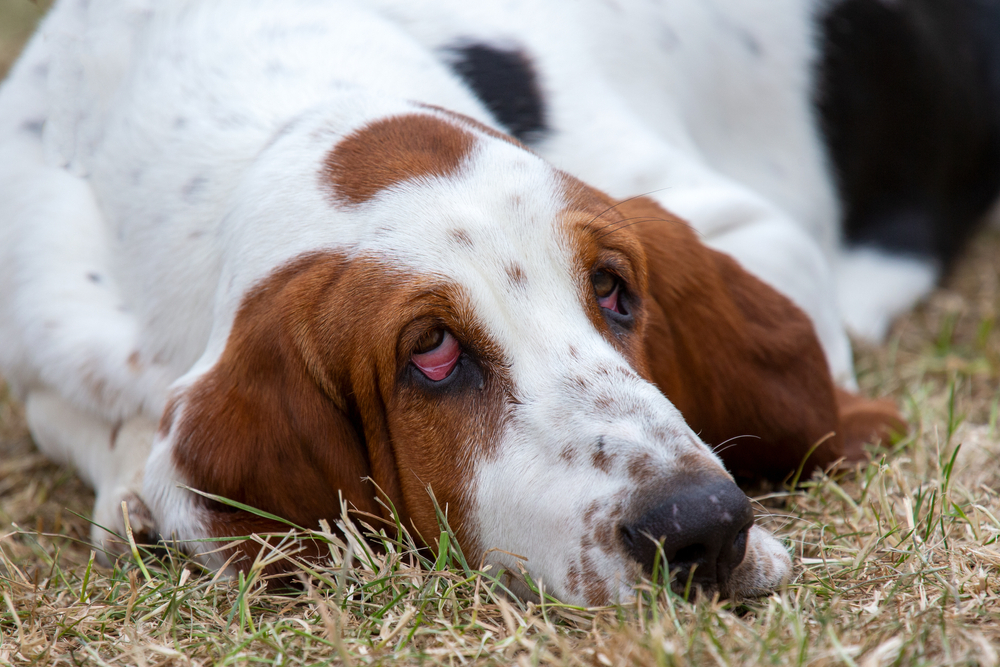
Facial structure is the biggest predictor. Flat-faced and heavy-folded dogs, Bulldogs, Pugs, Shar-Peis, and Chow Chows, are prone to entropion, while loose-lidded breeds like Bloodhounds, Basset Hounds, and Saint Bernards lean toward ectropion. Among cats, the flat-faced breeds such as Persians and Himalayans are the ones most likely to develop entropion. Some dogs, Bulldogs especially, carry both hereditary eyelid conditions at once. If your tearing-prone pet is one of these breeds, the lid is worth checking early.
When Does Tearing Actually Need Surgery?
Tearing needs a surgical fix when its cause is a structurally misplaced lid, and not before. If the watering comes from entropion or ectropion, drops and wipes only manage the surface while the friction or exposure continues, and the cornea keeps taking damage that can progress to corneal ulcers and scarring. In that situation, repositioning the lid is the definitive answer. If the tearing instead traces to allergies, a blocked tear duct, or an infection, surgery is the wrong tool, and the fix is medical or a duct-clearing procedure. This is exactly why confirming the cause comes before any talk of an operation.
How Do We Find the Cause of the Tearing?
Pinning down the cause takes a focused eye exam. We look at lid position at rest and during blinking, measure tear production with a Schirmer test among other ocular tests, stain the cornea to reveal ulcers, and check for eyelash problem that can mimic a lid issue. A topical anesthetic is one of the most telling steps: if numbing the surface relaxes the squint, the tearing was pain-driven, while a lid that stays rolled regardless is structural.
What Does Surgical Correction Involve?
When the lid is the cause, the approach fits the pet. Temporary eyelid tacking holds a lid in position for growing puppies or when pain is distorting it, buying time before a permanent decision. Tacking uses small sutures placed near the lid margin to pull the lid outward and away from the corneal surface, protecting the eye during the months when the face may still be changing. Some puppies grow out of mild entropion entirely with tacking alone; others go on to definitive surgery later, but in the meantime the cornea is spared from chronic damage.
Definitive eyelid surgery repositions the lid once anatomy is stable. The most common technique for entropion is called the Hotz-Celsus procedure, in which a precisely measured elliptical strip of skin is removed parallel to the affected lid margin, and the resulting incision is closed in a way that gently rolls the lid into proper position. For ectropion, the approach tightens the loose lower lid through a similar principle of removing and repositioning tissue to shorten the lid edge. The amount removed has to be calculated carefully, since too little leaves residual rolling and too much overcorrects into the opposite problem. A conservative approach is preferred, because a touch more tissue is easy to remove later if needed, but overcorrection cannot be undone.
For severe cases with multiple deformities, especially in heavy-skinned giant breeds, more complex combination repairs are sometimes needed. As an AAHA-accredited practice equipped for soft tissue surgery, we handle eyelid correction with customized anesthesia protocols, continuous monitoring throughout the procedure, and pain control built into both the surgical day and the recovery period. Pre-anesthetic bloodwork is standard before the procedure to identify any health concerns that affect anesthetic safety. Most pets are admitted in the morning, undergo surgery under general anesthesia mid-day, recover in the afternoon, and go home the same day with detailed discharge instructions.
Is Tearing Different in Cats?
Cats follow their own pattern. Entropion in cats tends to appear later in life and usually ties to chronic surface disease, such as conjunctivitis or feline herpesvirus, rather than the breed conformation seen in dogs. Their tearing often improves only when both the lid and the underlying viral or inflammatory problem are addressed together.
What Do Recovery and Maintenance Look Like?
Recovery is generally smooth, with most pets noticeably more comfortable within a few days as swelling settles and the chronic irritation finally stops. An Elizabethan collar is essential until the recheck, since one hard rub can undo the repair. We will also coach you through administering eye medications so the drops go easier.
A few practical notes on the recovery period:
- Activity restriction for the first 10 to 14 days. No rough play, no swimming, and ideally no head-shaking situations.
- Watch the incision daily for swelling, discharge, or any opening. Some pink-tinged discharge is normal in the first few days; bright red bleeding or pus is not.
- Keep eye medications on schedule. Missed doses slow healing, and the drops are doing real work to prevent infection and keep the surface comfortable.
- Don’t let your pet sleep with their face buried in soft bedding for the first few days, since that can produce friction on the incision.
- A suture-removal recheck around day ten to fourteen confirms the lid is sitting where it should and lets us decide when the e-collar can come off.
The cone stays on until sutures are out or we clear your pet. Beyond the initial recheck, most pets need no further surgical follow-up, and we will see them at their next wellness visit to confirm the long-term result. If you have questions at any time during the recovery process, just call us. We’re happy to help.
For pets prone to chronic eye issues, ongoing maintenance is mostly about catching changes early. A quick weekly look at the lids during your regular handling routine, watching for any return of squinting, redness, or one-sided tearing, and keeping the area around the eyes clean and trim are usually enough to flag problems while they are still small.
What Can You Do About the Tearing Before the Visit?
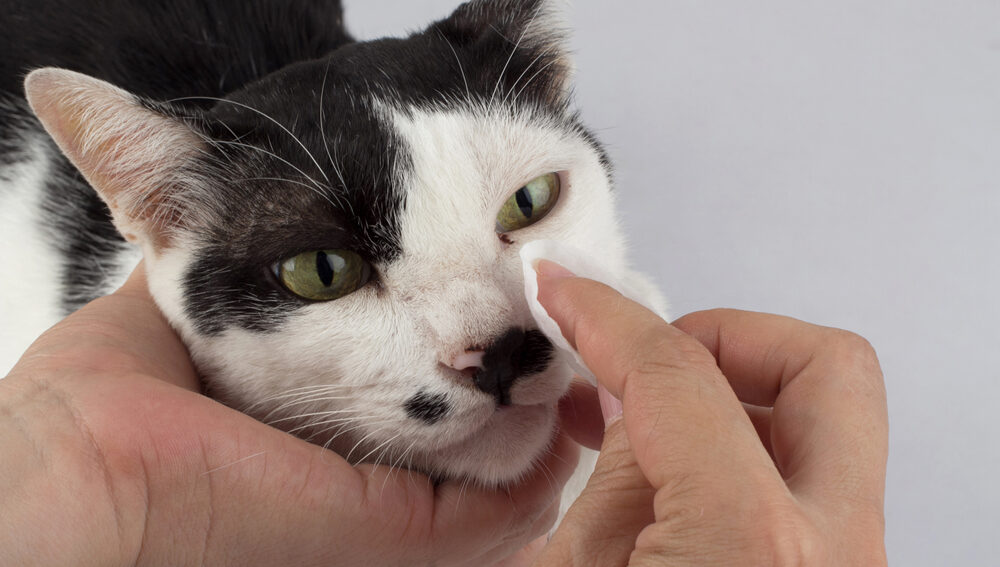
While you wait for an exam, a few gentle steps keep your pet comfortable without masking the problem. Wipe away discharge with a soft, damp cloth or a vet-approved eye wipe, working from the inner corner outward, and keep the fur around the eyes trimmed so it does not wick tears or poke the surface. Avoid human eye drops and leftover medications, since the wrong product can worsen an ulcer, and do not try to flush a clearly painful eye at home. If your pet is squinting hard, pawing, or the eye looks cloudy, treat that as a reason to be seen sooner rather than later. Put on an e-collar to keep your pet from causing further damage to their eye.
None of this fixes a structural lid problem, but it keeps the area clean and gives us a clearer starting point at the appointment.
Frequently Asked Questions About Tearing and Eyelid Surgery
Will Drops Alone Fix Constant Tearing?
It depends entirely on the cause. Drops and ointments manage tearing from allergies, mild irritation, or infection, but they cannot reposition a rolled or drooping lid. If the tearing keeps returning the moment treatment stops, a structural cause is likely, and that is the kind that needs surgery rather than another round of medication.
Is Tear Staining the Same as a Tearing Problem?
Tear staining is the reddish-brown mark left where tears overflow onto the fur, so it is a sign of excess tearing rather than a condition itself. Light staining in a healthy eye can be cosmetic, but heavy or one-sided staining with redness or squinting points to an underlying cause worth checking.
Can Entropion Go Away on Its Own?
In growing puppies, mild entropion sometimes resolves as the face matures, and temporary tacking holds the lid steady meanwhile. In adult dogs and cats, a structural lid problem does not self-correct and tends to worsen as the friction reshapes the lid further.
Will My Pet Need Surgery on Both Eyes?
Often, when both eyes are affected, though not always on the same day. We usually correct one eye at a time so the other stays comfortable during recovery, scheduling the second once the first is healing well. In some cases, when the changes are mild and symmetric, both eyes can be done under the same anesthesia, which spares your pet a second procedure and saves on cost.
Why Does My Pet Get Tear Staining on One Side Only?
One-sided staining usually means one-sided trouble. A lid rolling in, a blocked tear duct, or an irritant affecting a single eye will overflow tears on just that side, leaving a stain the matching eye does not have. Because a one-sided pattern points more toward a specific structural or drainage cause than a general one, it is worth having that eye checked rather than assumed to be cosmetic.
When Tearing Means More Than a Mild Irritation
Persistent tearing is rarely just a cosmetic nuisance. It usually means the surface of the eye is being irritated over and over, and the right next step is finding out why. When the answer is entropion or ectropion, surgical correction is the definitive fix and recovery is generally smooth.
If your dog or cat has been tearing persistently, squinting, or showing eye discomfort, request an appointment at our Harbor City location and we will take a careful look.