

How Everyday Pet Gear Can Impact Safety and Behavior
A quick scan of any pet store aisle reveals just how many products exist for dogs and cats, and how few of them come with a clear explanation of when or how they can cause harm. Retractable leashes are convenient right up until the cord causes a laceration or wraps around a child’s leg. Collars boasting “no-pull” seem like a great solution until they damage your dog’s neck. Toys sized for a smaller dog become choking hazards when a larger dog gets hold of them. Bones feel like a great way to entertain a dog that chews everything, until they break a tooth. Equipment safety is a topic that rarely comes up until something goes wrong, and by then the conversation has moved from prevention to treatment.
Harbor Pines Veterinary Center is an AAHA-certified practice serving Harbor City, CA, offering both in-clinic and mobile care for small animals. Our comprehensive surgical and treatment services are available when injuries require more than basic first aid, and we’re always glad to talk through safer equipment choices at any wellness visit. Request an appointment to address an injury or to get practical guidance on keeping your pet safer every day.
What Is Your Dog Telling You About Their Gear?
Before discussing which products to avoid, it helps to understand how dogs communicate discomfort. Dog body language is nuanced, and a lot of the signals that indicate a pet is stressed or in pain from their equipment are subtle enough to be missed.
Canine body language includes stress signals like repeated lip licking, yawning out of context, pinned ears, a tucked tail, and the “whale eye” expression where the whites of the eyes are visible. When these appear during walks or while putting on a harness, the equipment is worth reconsidering. Physical warning signs to watch for include increased reactivity to other pets, rough or noisy breathing on leash, reluctance to walk in familiar areas, pawing at the collar, and persistent sensitivity around the neck or shoulders.
A pet that visibly dreads getting their leash attached has a reason for it. We can evaluate posture and movement during a health exam and help identify whether discomfort has a gear-related cause.
Why Does Training Method Matter?
Positive reinforcement training works by rewarding the behaviors you want to see more of, building new habits through repetition and good associations rather than through pain or fear. It is more effective for long-term behavior change and does not carry the physical injury risks that aversive tools do.
The difference is clearest in a concrete example. Consider a dog who barks and lunges at other dogs on leash. It’s common for dogs that are anxious or overly-excited. With a prong collar, each time the dog reacts, the collar tightens and causes pain. The dog may stop lunging temporarily, but only because it hurts- not because they’ve learned the right way to behave. They start to associate other dogs with pain, and the underlying anxiety often increases. Some dogs redirect that anxiety into worse behavior.
Leash reactivity addressed through positive reinforcement uses techniques like the engage-disengage game to gradually change the dog’s emotional response to the trigger, building confidence over time. The result is a dog that genuinely becomes less reactive rather than one that is suppressing an unchanged fear response. Behavior guidance can be worked into any wellness visit at Harbor Pines.
Which Training Devices Should Be Avoided?
Prong Collars and Choke Chains
Prong collars work by applying concentrated pressure around the neck when a dog pulls, using pain as the deterrent. They do not teach a dog what to do instead of pulling. The dangers of “training” collars include bruising, swelling, tracheal damage, muscle injury, and in dogs who pull suddenly or lunge, potential damage to cervical vertebrae. Choke chains operate on the same principle and carry the same risks through a sliding-tighten mechanism.
Both tools are particularly risky for dogs already prone to airway problems, including brachycephalic breeds like Bulldogs and Pugs who we see regularly at Harbor Pines.
Shock Collars and Punishment-Based Tools
Aversive training methods including shock collars, citronella spray collars, and vibration correction tools can produce skin burns, fear responses, and worsened behavior. Dogs subjected to punishment during encounters with other people, animals, or unfamiliar stimuli can develop associations between those triggers and pain, which tends to increase rather than reduce aggression in dogs. The behavioral fallout from aversive tools often creates a more difficult problem than the one the owner started with.
Retractable Leashes
Retractable leash risks include reduced owner control, actively rewarding pulling behavior by letting the dog advance when they pull, and thin cords that can cause severe retractable leash injuries including cord burns and lacerations on both pets and people. Thin cords can snap when a large dog pulls quickly, and in a traffic situation or any moment requiring immediate control, a retractable leash simply cannot respond quickly enough.
For owners who need help managing a dog that pulls or is reactive on leash, reach out to us to discuss gear and training options that work safely.
What Walking Equipment Actually Works?
Harnesses and Collars
Harnesses distribute pressure across the chest and shoulders rather than concentrating it on the neck, making them a significantly safer option for leash walking. Front-clip harnesses redirect a pulling dog sideways, making pulling less effective and easier to manage. Back-clip harnesses work well for dogs that already walk without tension.
Fit matters enormously. A harness that rides too high restricts shoulder movement and causes discomfort; one that fits too loosely creates friction and can chafe over time. Choosing the right collar follows the same principle: a flat buckle collar or martingale collar fitted to the two-finger rule, where two fingers slide comfortably between the collar and the neck, provides secure identification tag attachment without posing strangulation risk during normal activity.
Standard Leashes and Long Lines
A four to six foot standard leash provides the control and communication necessary for everyday walks and supports reward-based training by keeping the dog within range for redirection and reward. Dogs learning to walk nicely on leash respond much better to a leash that allows the handler to feel and respond to subtle tension changes.
For recall training in open areas, long line training using a 15 to 30 foot line provides freedom of movement without the hazards of a retractable cord. Long lines should be used away from traffic and other dogs and always on a harness rather than a collar.
Which Toys Can Cause Injuries?
Toy-related injuries, from choking to surgical emergencies requiring removal of gastrointestinal foreign bodies, are a consistent part of what we treat. The list of commonly problematic toys is longer than most owners expect:
- Undersized toys: any toy that fits past the back molars is a swallowing risk for that individual animal
- Hard plastic toys: can fracture teeth or shatter into sharp-edged pieces
- Stuffed animals without supervision: fabric and filling are readily swallowed and can cause intestinal obstruction
- Tennis balls: the abrasive felt surface wears tooth enamel with regular use, and the ball can compress enough to lodge in the throat of a medium or large dog
- Rope toys: fibers swallowed over time accumulate in the intestines and can form linear foreign bodies that require surgery to remove
- Toys with squeakers: the squeaker becomes a choking hazard the moment it is extracted, which takes most determined dogs about four minutes
Replace worn or damaged toys before they become hazards, and supervise initial play with any new toy until you know how your dog interacts with it. Reach out to us if a pet swallows toy parts or shows signs of distress including vomiting, retching, or refusal to eat.
Which Chews Are Actually Risky?
Chewing is healthy. The specific chew matters enormously. Dangerous chew items that we regularly treat injuries from include:
- Cooked bones: the cooking process makes them brittle; they splinter into sharp fragments that lacerate the mouth, throat, and intestines
- Raw bones: even these can fracture teeth and cause gastrointestinal injury, particularly in aggressive chewers
- Antlers and hooves: extremely hard surfaces cause slab fractures of the premolars and carnassial teeth, which are painful and expensive to treat
- Hard nylon bones: use the thumbnail test, pressing your fingernail firmly into the surface. If it leaves no impression, the material is hard enough to crack teeth
- Rawhide: large pieces swallowed whole can cause choking or obstruction, and rawhide softens into a mass that is difficult for the digestive system to break down
- Bully sticks or natural chews gnawed to a small nub: any chew becomes a choking hazard at the point where a dog can fit the remainder past their back teeth
Signs of a chew-related problem include drooling, pawing at the mouth, gagging, vomiting, bloody stool, or unusual abdominal sensitivity. We can assess and treat chew-related tooth damage through our dental care services, and handle obstructions that require surgical intervention.
What Are the Safer Alternatives?
There are excellent options that satisfy a dog’s need to chew without the injury risk. The thumbnail test is the most reliable guide: press your fingernail firmly into the chew. If it gives, the material is safer on teeth. If your nail leaves no impression at all, set it aside.
Safe chew toys for most dogs include:
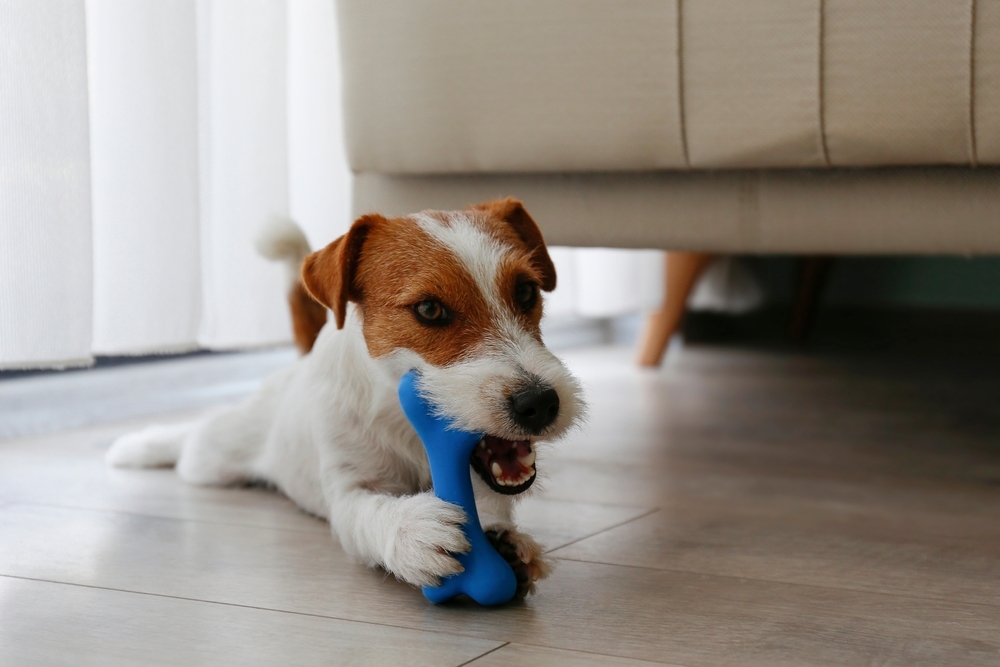
- Durable rubber toys that can be stuffed with food, frozen, and offered as extended enrichment
- Appropriately sized dental chews that carry the VOHC (Veterinary Oral Health Council) seal, confirming efficacy for plaque and tartar reduction
- Frozen carrots or stuffed frozen rubber toys for teething puppies
- Puzzle feeders that direct chewing energy toward problem-solving
We carry a selection of dental chews and treats in our online pharmacy that meet safety standards and support oral health at the same time.
When Behavior Is Part of the Picture
Equipment choices alone do not fix behavioral problems, and sometimes destructive chewing or reactivity has a medical component worth ruling out. A dog in chronic pain from neck or joint issues may become more reactive on leash; a dog with dental pain may change how and what they chew. The connection between physical discomfort and behavior is real and worth investigating before assuming the problem is purely training-related.
Request an appointment to address both the physical and behavioral dimensions at once, and come in with questions about gear, training tools, or chew options. We can make personalized recommendations based on your pet’s size, chewing intensity, and temperament.
FAQ: Pet Equipment and Product Safety
How do I know if a toy is the right size for my dog?
If the toy can fit past your dog’s back teeth or be swallowed whole, it’s too small. When in doubt, size up.
Are “natural” chews always safe?
No. Antlers, hooves, and raw or cooked bones all carry real risks of tooth fracture or obstruction. Use the thumbnail test and supervise any new chew the first time.
Are prong collars really harmful for dogs that pull hard?
Yes. They work by causing pain and do not teach the dog what to do instead of pulling. Front-clip harnesses combined with reward-based training are more effective and do not risk throat or neck injury.
Do cats face the same toy hazards?
Yes. String, ribbon, linear toys, and small parts are significant hazards for cats. Linear foreign bodies are one of the more common surgical emergencies in cats.
When should I call the vet after a toy or chew incident?
Call if you see gagging, pawing at the mouth, excessive drooling, vomiting, refusal to eat, bloody stool, or abdominal tenderness after a chewing session.
Is a harness always better than a collar for walking?
For most dogs, a harness is better for leash walking because it protects the neck and reduces pulling mechanics. A flat collar is still important for ID tags and for situations where a harness is not being worn.
Safer Gear Is Better Care
Choosing appropriate equipment, toys, and chews is one of the most accessible things a pet owner can do to prevent injury. It does not require expensive products or complicated decisions. It requires knowing what the risks are and matching the gear to the individual pet.
We’re here to help with that assessment, whether through a wellness visit conversation, a post-injury evaluation, or a quick question at the front desk. Request an appointment or call (310) 517-1832 to connect with us.